

Why Do I Get Sleepy While Reading but Feel Awake When I Go to Bed?
A clear explanation of why reading can make you drowsy, why that sleepiness can disappear when you get ready for bed, and how your evening routine can accidentally wake your brain back up.


You are trying to do the right thing. You put away the more stimulating parts of the evening, choose a quieter activity, and start reading because it feels calmer than scrolling, watching TV, or staying busy until the last possible minute. Then it works almost too well. Your eyes get heavy, the page starts to blur, and you feel like you are finally close to sleep.
But then you stop reading, get ready for bed, lie down, and somehow the sleepiness disappears.
That can feel incredibly frustrating. It is not just annoying that reading made you tired. It can feel like your body gave you a clear signal — go to sleep now — and then took it back the moment you actually tried. You may even feel like you wasted the sleepy window. You were trying to support your sleep, not sabotage it.
The short answer is that the sleepiness was probably real, but fragile. Reading can lower stimulation, narrow your attention, relax your body, and help you drift toward sleep. But the transition from reading to “going to bed” can interrupt that state. Getting up, turning on lights, brushing your teeth, checking your phone, changing rooms, or thinking “now I have to sleep” can shift your brain back toward alertness.
This article is about that exact pattern: getting sleepy while reading, but feeling awake once you actually try to sleep.
The short answer
If you get sleepy while reading but feel awake when you go to bed, it usually means reading helped your body move toward sleep, but the transition afterward woke you back up.
That transition may seem small. You close the book, stand up, use the bathroom, brush your teeth, adjust the room, plug in your phone, set the alarm, maybe check one last message, then finally lie down. None of those steps has to feel exciting or dramatic. But together, they can be enough to move your brain out of a quiet, drifting state and back into a more alert one.
This does not mean reading is bad before bed. It also does not mean you “weren’t really tired.” It often means the sleepy state you entered while reading was easy to disturb.
Sleepiness is not always a switch that stays on once it appears. It is a state your body moves into when the signals are right. If the signals change, the state can change too.
Why reading can make you sleepy
Reading often makes people sleepy because it reduces stimulation.
When you read, especially at night, your attention narrows. Instead of responding to a stream of sounds, notifications, conversations, videos, tasks, and decisions, your brain follows one line of thought. The room may be quieter. The light may be dimmer. Your body may be still. Your breathing may slow. Your posture may become more relaxed.
That combination can make reading feel like a bridge between wakefulness and sleep. It gives your mind something gentle to hold onto without demanding the same level of alertness as work, conversation, or bright screens.
Reading can also reveal sleepiness that was already there. You may think, “Reading made me tired,” but sometimes reading simply removes enough stimulation for you to notice how tired you already were. During the day or early evening, activity can keep you going even when sleep pressure is building. Once the activity drops, the tiredness becomes more obvious.
This is one reason reading before bed can be useful. It can create a lower-stimulation environment where sleep has a chance to emerge naturally. The problem begins when the sleepiness that appears during reading does not survive the next step.




Why that sleepiness can disappear
The sleepy feeling you get while reading can be fragile because it depends on the conditions that created it.
While reading, you may be still, warm, quiet, mentally absorbed, and under dim light. Then bedtime begins, and the conditions change. You stand up. You move through a brighter room. You brush your teeth. You look at the time. You remember something you forgot to do. You check whether your alarm is set. You think about tomorrow. You lie down and start monitoring whether sleep is happening.
Each of those changes can increase alertness slightly. The effect may be subtle, but sleep onset is sensitive. Your body does not need a major shock to become more awake. Sometimes a small increase in light, movement, temperature, mental effort, or emotional pressure is enough.
This is especially true when you were only lightly drowsy. There is a difference between being deeply ready to sleep and being in a gentle pre-sleep drift. Reading often creates the second state. You may feel close to sleep, but not yet fully committed to it. If you interrupt that state too much, your brain may return to wakefulness.
That can make the experience feel confusing. A few minutes earlier, you were struggling to keep your eyes open. Now you are lying in bed wondering why nothing is happening.
The bedtime transition problem
For many people, the real issue is not reading itself. It is the transition between reading and sleeping.
A good reading routine may lower stimulation, but a clumsy transition can raise it again. This creates a mismatch: the first part of the routine tells your body that the day is ending, and the second part tells your body that there is more to do.
This can happen when reading takes place before the rest of the bedtime routine. For example, you may read on the couch until you get sleepy, then get up and begin the actual sequence: bathroom, lights, teeth, skincare, water, phone, alarm, bedroom, blankets. By the time you finish, the sleepy state may be gone.
It can also happen when reading happens in bed, but you still add small alerting steps afterward. You may read until you are drowsy, then sit up, turn off a lamp, move pillows, check the time, put the book away, adjust the thermostat, or think through whether you have enough hours left to sleep.
None of this is wrong. Real evenings are not perfectly smooth. But if the pattern keeps happening, it is worth noticing where the transition wakes you up.
The key question is not only, “Does reading make me sleepy?” It is also, “What happens after I get sleepy?”


Why light, movement, and phone checks matter
Light is one of the clearest signals your brain uses to understand whether it is day or night. Bright light in the evening can make your body more alert, especially if it comes after you have already been sitting in a dimmer environment. Even a short trip into a bright bathroom can feel more activating than you expect.
This does not mean every light must be eliminated or that you need a perfectly dark house before bed. The practical point is simpler: if reading makes you drowsy in dim light, then bright light afterward may partially undo the effect. Your body was getting a nighttime signal, and then it got a stronger wakefulness signal.
Movement can work the same way. Standing up, walking around, washing your face, brushing your teeth, changing clothes, or tidying the room all increase physical activation. They are normal parts of getting ready for bed, but they are still activity. If you do them after you become sleepy, they may pull you out of the state that reading helped create.
Phone checks are especially common because they look harmless. You may only want to set an alarm, check the weather, or make sure there are no urgent messages. But the phone can introduce bright light, decisions, social information, time pressure, and emotional content all at once. Even a “quick check” can move your mind from passive drifting to active processing.
If this pattern is happening often, the phone is one of the first things to examine. Not because the phone is the only cause, but because it can compress several wake-promoting signals into a few seconds.
If late screens are part of the pattern for you, How Screens Delay Sleep Onset goes deeper on why that shift can happen so fast.
Why “trying to sleep” can wake you up
There is another reason the sleepy feeling can disappear once you get into bed: trying to sleep can become mentally activating.
Reading gives your mind something gentle to follow. You are not directly asking, “Am I asleep yet?” You are just reading. If sleepiness appears, it appears indirectly.
But once you close the book and lie down, attention can shift from the story to sleep itself. You may start checking your body: Am I tired enough? Why am I awake again? How long will this take? What if I miss the window? How many hours do I have left?
That monitoring can wake you up because it turns sleep into a performance. Instead of drifting, you are evaluating. Instead of relaxing into a state, you are trying to make the state happen.
This is one of the most frustrating parts of the pattern. The harder you try to protect the sleepy feeling, the more fragile it can become. You may lie there with your eyes closed, but mentally you are working.
This does not mean the problem is “all in your head.” It means the mind is part of the sleep transition. The body may be ready to move toward sleep, but the moment can be interrupted by attention, pressure, and the feeling that sleep has become a task.
This overlaps with a broader pattern covered in Why Can’t I Fall Asleep Even When I’m Tired?, but here the problem often starts with a sleepy, low-stimulation reading state that gets interrupted. Reading may help you stop trying for a while. Bedtime may accidentally make you start trying again.
Should you read in bed or somewhere else?
There is no single rule that fits everyone.
Some people do well reading in bed because it reduces the transition. They finish the page, put the book down, turn off the light, and sleep. For them, reading in bed may be a simple way to keep the sleepy state intact.
Other people do better reading somewhere else because bed has become associated with frustration, wakefulness, or too much mental effort. If getting into bed triggers the thought “now I have to sleep,” then reading in another quiet place may feel easier. In that case, the challenge is making the movement from reading spot to bed as smooth and low-stimulation as possible.
The more important question is not whether reading happens in bed or outside of bed. The more important question is whether your setup preserves sleepiness or interrupts it.

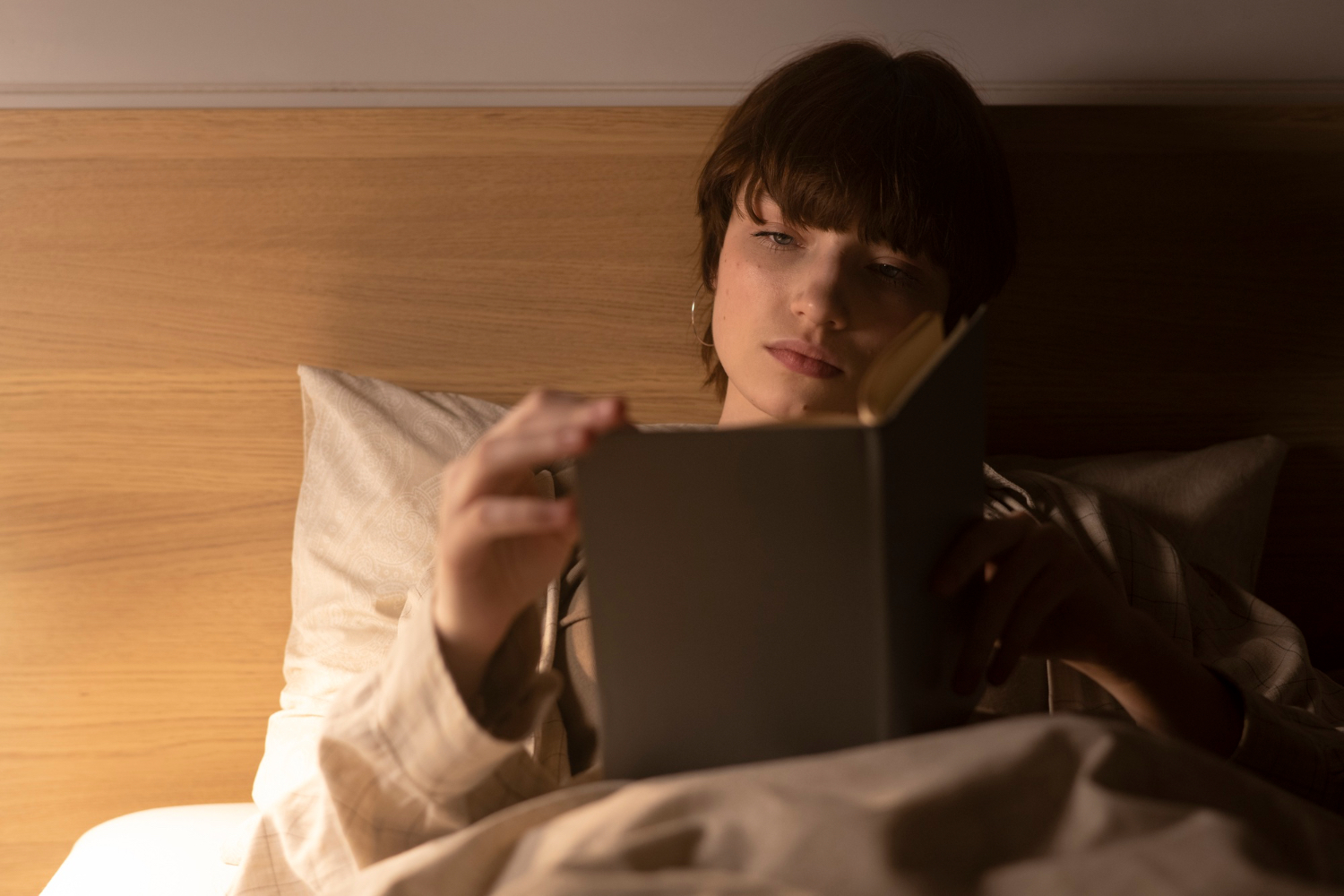
Reading in bed may work better if:
- you can get ready for bed before you start reading
- the light is dim and easy to turn off
- you do not need to check your phone afterward
- putting the book away does not require much movement
- lying down does not make you start monitoring sleep
Reading outside of bed may work better if:
- bed has started to feel mentally pressurized
- you tend to read too long in bed even after you are sleepy
- you need a separate wind-down space before sleep
- your bedroom setup makes reading awkward or too bright
The best option is the one that makes the transition into sleep quieter, not the one that follows a universal rule.
How to use reading without accidentally waking yourself up
If reading makes you sleepy but bedtime wakes you back up, the goal is not to add a complicated routine. The goal is to reduce the number of things that happen after sleepiness appears.
A simple experiment is to move more of the bedtime routine before reading. Brush your teeth, use the bathroom, change clothes, set the alarm, adjust the room, and handle anything practical before you open the book. Then reading becomes the final bridge into sleep, not the activity that happens before another round of tasks.
This can change the whole pattern. Instead of getting sleepy and then starting bedtime, you complete bedtime first and then let reading carry you toward sleep.
It can also help to make the reading environment closer to the sleeping environment. If you read in bright light and then move into a dark room, the contrast may be fine. But if you read in dim light and then step into bright light afterward, the direction is reversed. Try to keep the final part of the evening moving toward lower light, less movement, and fewer decisions. If you want the bigger whole-day version of that idea, What a Daily Plan for Better Sleep Actually Includes connects the bedtime transition to the rest of the signals your body receives.
Keep the book easy to stop. Some books are so gripping that they create the opposite problem: you feel sleepy, but the story keeps pulling you forward. Others are so dense that they make reading feel like work. The ideal bedtime reading is interesting enough to hold your attention but not so stimulating that it pulls you into high alert.
Most importantly, avoid turning the moment you stop reading into a test. You do not need to ask, “Will I fall asleep now?” You are trying to keep the transition boring, quiet, and almost forgettable.
A better sequence might look like this: get fully ready for bed, dim the lights, read until you feel naturally drowsy, stop before you fight to stay awake, turn off the light, and let the next step be as small as possible.
That is not a list of sleep tips. It is one specific adjustment for one specific problem: protecting the sleepy state that reading already helped create.
What if reading makes you sleepy too early?
Sometimes the frustration is slightly different. You may want to read at night because you enjoy it, but you get sleepy after only a few pages. Then you give up, go to bed, and suddenly you are awake again. In that case, reading is not only failing as a sleep bridge. It is also interfering with something you actually wanted to do.
This can happen when reading is the first quiet moment of the evening. Your body may have been carrying sleep pressure for hours, but the rest of the night kept you stimulated enough to ignore it. As soon as you sit still, your brain gets the message that it can finally let go.
If you want to read for enjoyment, you may need a different reading window. Reading earlier in the evening, before you are already close to sleep, may help you enjoy the book without turning it into an accidental drowsiness trigger. Then the pre-sleep version of reading can stay shorter, lighter, and more clearly connected to winding down.
This distinction matters because “reading before bed” can mean two different things. It can be a real hobby, or it can be a sleep transition. Those may need different timing.
The bigger pattern: sleepiness is a state you can interrupt
The most important idea is that sleepiness is a state, not a guarantee.
You can be genuinely sleepy while reading and genuinely awake ten minutes later. That does not mean your body was lying to you. It means the conditions changed.
Reading may lower stimulation enough for sleepiness to appear. Then light, movement, phone checks, mental pressure, or the effort of “trying to sleep” may raise stimulation again. The result is the strange pattern where you almost fall asleep with a book in your hand, then feel awake once your head is on the pillow.
If this keeps turning into an early-evening crash followed by late-night alertness, Why Am I Sleepy at 8 PM but Wide Awake at Bedtime? covers the broader version of that pattern.
Once you see the pattern this way, the solution becomes more precise. You are not trying to overhaul your whole life or follow a generic checklist. You are trying to protect the final transition.
The best question to ask is: what happens between the moment I first feel sleepy and the moment I actually try to sleep?
If that gap contains bright light, activity, decisions, phone use, or pressure, that may be where the sleepy state is getting interrupted.
Bottom line
If you get sleepy while reading but feel awake when you go to bed, the reading probably did help. It lowered stimulation and helped your body drift toward sleep. The problem is that the next step may have woken you back up.
Try making reading the last quiet step instead of the thing you do before the rest of bedtime. Get ready first, lower the lights, avoid phone checks afterward, and make the transition from book to sleep as small as possible.
The goal is not to force yourself to sleep the moment your eyes get heavy. It is to stop accidentally interrupting the sleepiness that has already started to arrive.
Next up
If this pattern sounds familiar, you may also want to read Why Am I Sleepy at 8 PM but Wide Awake at Bedtime? for a broader look at why early-evening sleepiness can disappear later at night.
For the deeper biology behind tiredness building through the day, read Sleep Pressure and Adenosine: Why You Get Sleepier the Longer You’re Awake.
For the larger daily-plan view, read What a Daily Plan for Better Sleep Actually Includes.